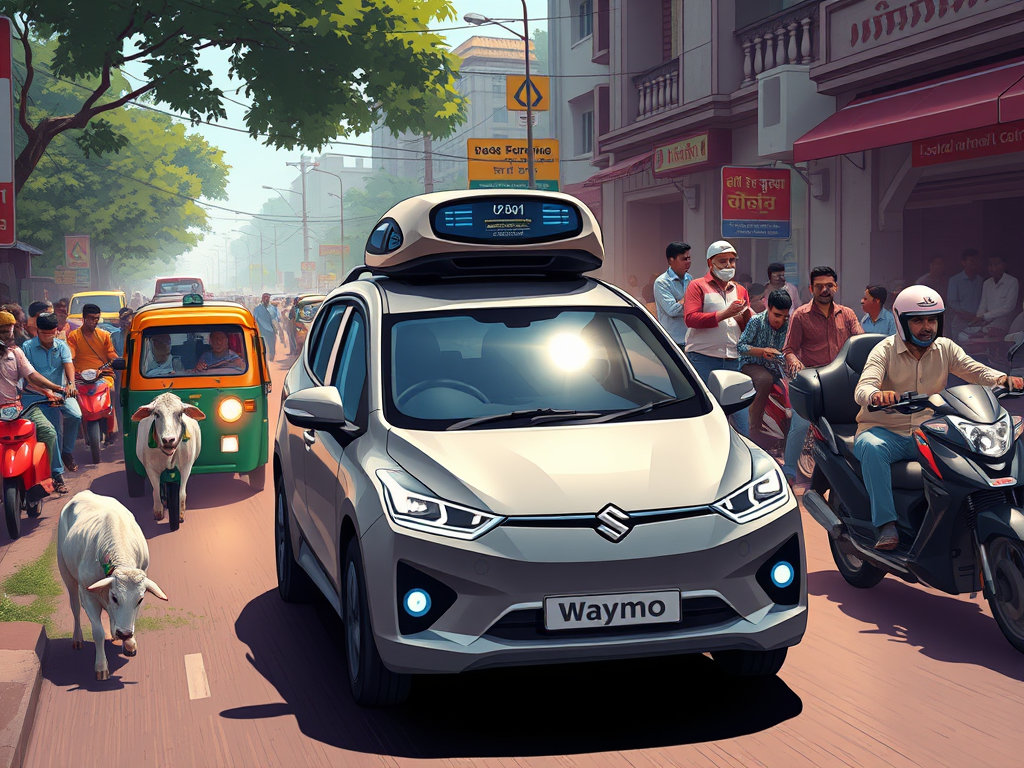
Silicon Valley built the world’s smartest car. New Delhi will break it in 20 minutes.
Waymo’s self-driving car has handled San Francisco’s steep hills, Los Angeles’s tough freeway merges, and Phoenix’s extreme heat. It has driven 20 million miles on real roads and keeps breaking safety records. Some analysts even say it’s the future of city travel.
But all that means nothing on Mehrauli-Badarpur Road (Delhi) at 9 AM on a Monday.
Picture yourself in a Waymo. The sensors are humming, the LIDAR is spinning, and the computer, trained on endless driving data and making 30,000 decisions every second, seems sure of itself.
Suddenly, an autorickshaw with six people and a refrigerator appears on your left. On your right, there’s a cow. Straight ahead, a man is backing up a Maruti Suzuki the wrong way down a one-way street, talking on his phone and eating a paratha (Indian snack).
At this point, Waymo isn’t so confident anymore.
The Signal Is a Suggestion
Waymo’s whole system is built on one idea: traffic rules exist, and most people follow them. Red lights mean stop. Lane markings mean stay in your lane. Pedestrian crossings mean you should yield.
In New Delhi, a red light is just a suggestion. Lane markings are mostly for decoration. Pedestrian crossings are often where the biryani(food) stall sets up. The car’s AI knows what assertive driving looks like.
It understands aggressive lane changes and drivers who cut in close. But it has never seen, and can’t really handle, the negotiation-based traffic at every intersection in India. On Delhi roads, there aren’t really rules — just a kind of agreement, worked out through a constant conversation of horn beeps.
The short beep: I see you.
The long beep: I am coming through regardless.
The repeated rapid beep: This is not a warning; this is a declaration.
The continuous 45-second honk: I have given up on life, and I am taking everyone with me.
Waymo doesn’t understand this way of driving. It will wait patiently at an intersection, looking for a gap in traffic that never comes on Delhi roads. Meanwhile, a Bajaj Pulsar (motorbike) will zip by at 60 km/h, a school bus will slowly move forward at an angle, and three pedestrians will appear from places you didn’t know existed.
Waymo will keep recalculating. When it can’t find a way forward, it will quietly pull over and send a 400-page incident report to Waymo HQ.

Lane Awareness Is a State of Mind
Autonomous cars in America understand lanes. They learn to drive between lines, use turn signals when changing lanes, and maintain a buffer between themselves and other vehicles.
Waymo thinks its lane width is 3.5 meters. It detects 2.7 meters of clear space with its sensors because a bus is illegally hogging the left lane, and a tempo is travelling outside its lane by 80 centimetres, with mattresses stacked on it. The mattresses aren’t mapped into Waymo’s system and never will be.
Waymo will creep forward, trying to collect more data. The mattresses will scoot over, but get replaced by a guy on a bicycle with a tower of egg trays protruding from him. Waymo will creep forward some more. Repeat until either Waymo reaches home or the world comes to an end (whichever is sooner).
The Pedestrian Problem
Waymo’s pedestrian detection algorithms are excellent. Waymo can detect a pedestrian from 200 meters away, predict their trajectory, assess whether they might enter the vehicle’s path, and bring the car to a stop if necessary.
They cannot detect 27 pedestrians simultaneously crossing the street from nine directions — including three walking backwards while looking at their phones, a child after a cricket ball, an older adult pausing in the road to see who called him, and two pedestrians standing stock still without any indication of their intentions.
At a busy East Delhi market, pedestrian behaviour isn’t something you can predict. It’s a force of nature you just have to deal with. People cross where there’s no crossing. They cross when the light is red.
They cross while the light is changing, taking a chance on the gap. They cross and then come back because they forgot something, crossing twice in a direction that makes no sense. Waymo has to stop for every pedestrian in or near its path, both by law and ethics.
In Delhi, this means it will stop about every 11 seconds. A five-kilometre trip to Lajpat Nagar will take four hours. The passenger, who first praised the “futuristic experience,” will have left the car after 45 minutes and taken a Rapido.
The Special Case of the Junction at Azadpur
Every city has a traffic moment that sums it up. In New York, it’s Manhattan gridlock. In Mumbai, it’s the Western Express Highway at 6 PM. In Delhi, it’s Azadpur Chowk, a roundabout so chaotic that traffic police don’t even try to direct traffic. They just watch, like someone watching a storm.
At Azadpur, vehicles come from six directions. There’s a roundabout, but people often ignore it and drive straight through, powered by willpower and confusion.
Trucks, autos, e-rickshaws, school vans, motorcycles with three passengers, and even a man on a horse once all shared the space, following rules that everyone has quietly replaced with their own system.
Waymo’s navigation will send it through Azadpur just once. When its AI sees the intersection, it will get stuck in what engineers call an “edge case loop.” The situation is so different from anything it knows that it can’t decide what to do.
The car will slow to a crawl, turn on its flashers, and run all its sensors at full power. It’s 47 cameras that will record everything, but the car won’t move.
An autorickshaw driver will eventually lean out of his window and shout:
“Arey bhai, chalao!” — Come on, man, drive!
The car will not understand Hindi. The autorickshaw will then go around it. Everyone else will too.
Waymo will sit in the middle of Azadpur Chowk, patiently waiting for a break in traffic, while the city moves around it like water around a stone. Honestly, it’s almost beautiful if you think about it.
The Cow Variable
No story about Indian traffic is complete without mentioning the cow.
Waymo can detect animals. It classifies them and predicts their movement. It knows dogs, cyclists, and in America, the occasional deer or coyote. It handles these with grace.
But it’s never faced a cow that isn’t moving, doesn’t plan to move, and has been there since Tuesday. A cow in the middle of a Delhi road isn’t an obstacle like a broken-down car or a crossing pedestrian. It’s a feature, a permanent part of the road that everyone else has learned to drive around, like a rock in a river.
Waymo will stop. The cow will look at the car with the calm indifference of an animal that has seen it all and isn’t bothered by any of it. The car will wait for the cow to move. The cow will not move.
The car will calculate alternative routes. The alternative route has a cow, too. The car will flag the situation to human operators. The human operators, somewhere in San Francisco, will stare silently at their screens.
Somewhere in the back of the car, a passenger will sigh, shake his head and open the Uber app.
What Waymo Would Actually Need
For Waymo to work in New Delhi, it would need more than a software update. It would need a whole new way of thinking.
The car would have to realise that Indian traffic isn’t about rules, it’s about relationships. Every move is a negotiation, every gap is a conversation. Indian drivers can handle what looks like chaos because they understand an unspoken social contract.
It only works when everyone is human, can read body language, exchange glances, and quickly judge what others plan to do. AI doesn’t have body language, and it can’t exchange glances.
Maybe the answer is to train a model entirely on Delhi dashcam footage, and there’s plenty of that — Indian dashcam YouTube is a genre of its own. Maybe the breakthrough comes from a mode where the car beeps more aggressively and treats lane markings as optional.
Or maybe the honest answer is that Waymo, for all its real engineering brilliance, has found the one place where the edge case is not an exception.
Here, the edge case is the whole road.
The Good News
India does want self-driving cars. Tata, Mahindra, and the government’s Smart Cities mission are all looking into the future of autonomous vehicles. But every Indian engineer working on this knows something their Silicon Valley peers are still learning: the hardest part isn’t the technology.
It’s the roads themselves.
And the cows, of course.
And the refrigerator is still riding on the autorickshaw. Until Waymo builds a car that can look a Delhi driver in the eye, read his mind from the angle of his steering wheel, and truly understand that the horn means ‘I am coming through,’ Delhi will stay the last, unconquered frontier of autonomous driving.
And honestly, that seems fair enough.
If this made you laugh and cringe at the same time, you probably grew up near a traffic circle in India. Share it with someone who still drives there or has a similar experience.
Leave a Reply